
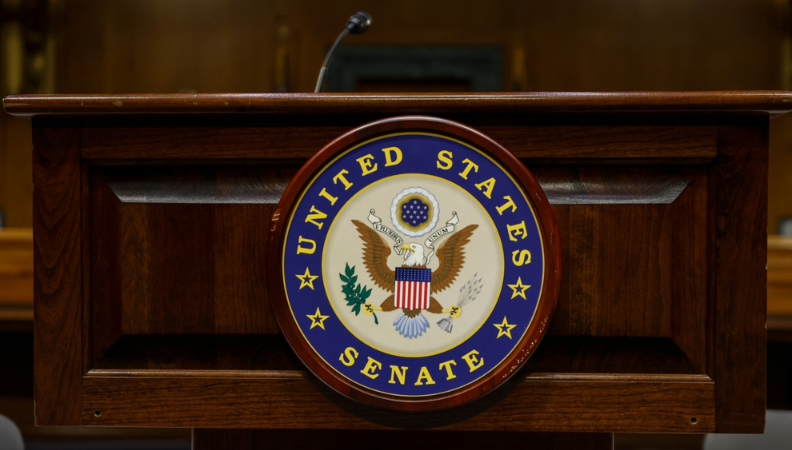
Members of the Senate Foreign Relations Committee are considering stronger export controls and increased investment in the U.S. workforce to combat China’s race against the United States for artificial intelligence (AI) dominance.
After the Trump administration and Beijing released their AI blueprints this summer, it became clear that the United States leading the world in AI “benefits the free world” while China would reshape the global system with “authoritarian values,” according to Sen. Pete Ricketts, R-Neb., chairman of the Subcommittee on East Asia, The Pacific, and International Cybersecurity Policy.
Speaking during a hearing Tuesday afternoon, senators on both sides of the aisle agreed that more must be done to prevent China’s rise to power in the AI space. While China hasn’t been as successful as the United States so far in its efforts toward that goal, the senators said access to American-made chips and equipment threatens U.S. progress.
“At the core of compute are advanced AI chips, the best of which are made by American companies. Denying Beijing access to these chips is therefore essential,” Ricketts said.
Ranking Member Chris Coons, D-Del., announced his plans to introduce the Safe Chips Act with Ricketts that would statutorily put in place the Trump administration’s current restrictions on what AI chips can be sold to China for 30 months.
“China’s been working overtime with us for more than a decade, using state-backed policies to invest massively in accelerating AI adoption,” Coons said. “They have poured money into research, development, deployment … but [are] struggling to produce advanced AI chips.”
Coons noted that Howard Lutnick, secretary of commerce, recently told Congress that China can only produce 200,000 advanced AI chips each year, while the United States and its allies can produce more than 10 million.
“This is our sole competitive critical advantage in AI, and we cannot squander it,” Coons said.
Chris Miller, a professor at Tufts University, told lawmakers that most of the world’s AI models are trained or deployed on American-made chips or those created by American allies. China is unlikely to catch up there, Miller said, but he warned that China has a stronger workforce.
“China’s educational system is impressive in the number of engineers, it turns out, and we’ve seen over the last couple of years that Chinese engineers … are very capable of devising AI models that are almost as good as those United States,” Miller said, adding, “It’s fundamentally important the United States also retains its advantages and talent.”
Beyond strengthening the U.S. workforce, Miller told senators that the nation also needs to tighten its export controls.
“Once a chip crosses into China, we have no further control over it,” Miller said, adding that he believes there are “further steps to be taken on the sale of chip-making equipment to China, where there are still real gaps and export controls.”
Gregory Allen, senior adviser at the Wadhwani AI Center at the Center for Strategic and International Studies, called for expanded controls on chip-related equipment.
“The biggest challenge that we have to sustaining these export controls over the long term is on the equipment, because China … [is] capable of designing decent chips. What they cannot do is make decent chips, and that entirely hinges upon our ability to keep the equipment out there,” Allen said.