
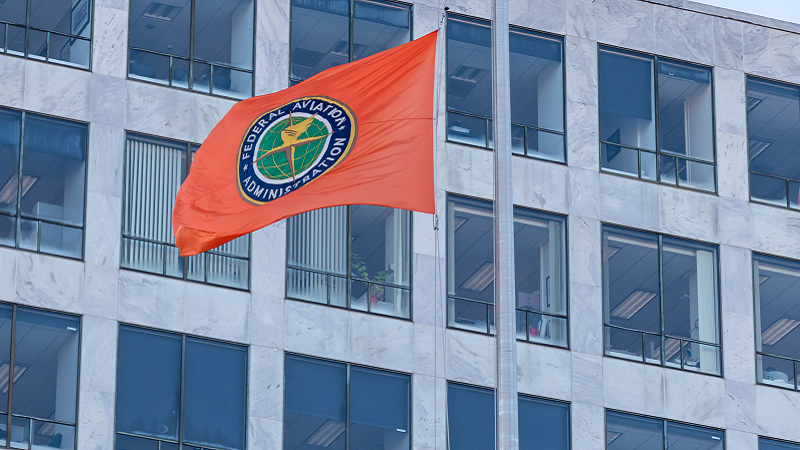
The Federal Aviation Administration (FAA) plans to open new offices dedicated to safety oversight and airspace modernization as part of an overhaul of the agency’s organizational structure.
The FAA announced the reorganization Monday, which it said will be the largest undertaken in the agency’s history.
The reorganization effort supports “Flight Plan 2026,” the agency-wide strategy that the FAA announced in December. The plan focuses on three pillars: people, safety, and National Airspace System modernization.
The new safety oversight office will implement a single safety management system (SMS) and risk management strategy for the FAA. The agency noted this will allow employees to share safety data more freely.
Other changes will include a new airspace modernization office to drive the installation of a new air traffic control (ATC) platform “at Trump Speed,” as well as an advanced aviation technologies office to manage the integration of drones, eVTOLs, and other air mobility vehicles into U.S. airspace.
The plan will also shift more key leadership roles into permanent posts and centralize management of finance, IT, and human resources under FAA Administrator Bryan Bedford.
Notably, structural changes will not result in any personnel cuts, the FAA said.
Last summer, Bedford laid blame on the FAA’s current leadership and safety culture for multiple technical failures and deadly incidents, saying a complete overhaul of the FAA would no longer let it rely on “half measures.”
Speaking before Congress during his confirmation hearing, Bedford said he would “work closely with the professional men and women of the FAA to provide the leadership that is necessary to execute the president’s vision, to build a new, best-in-class air traffic control system and to rectify the chronic understaffing [of] our nation’s peer centers.”
Modernization efforts and FAA oversight are key concerns among legislators after a series of technological failures resulted in mass airport delays and safety concerns in Washington over the last few years.
A primary focus of Congress has been the nation’s ATC systems, components of which date back to the 1960s.
The reconciliation bill passed in July provided a $12.5 billion down payment to modernize those systems, and companies Peraton, RTX, and Indra have been respectively named as the FAA’s prime integrators and as contractors to oversee radar systems.
Transportation Secretary Sean Duffy noted in a statement that funding was “only one piece of the puzzle,” and that the organizational overhaul will make rolling out those efforts more efficient.
“With these critical organizational changes, the FAA can streamline the bureaucracy, encourage innovation, and deliver a new air traffic control system at the speed of Trump – all while enhancing safety,” Duffy said.