
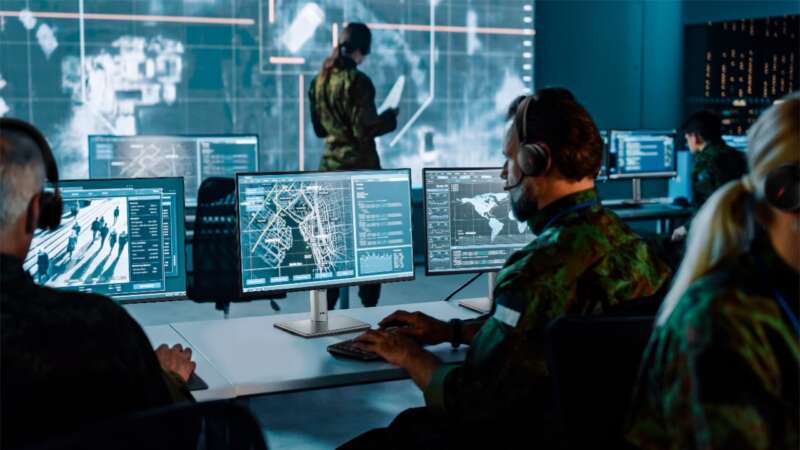
Mission partner environments (MPEs) are moving from static, stove-piped networks to dynamic, warfighting fabrics that deliver seamless interoperability – enabling the U.S. and allied partners to share data securely and act on it at operational speed.
In a recent conversation, experts from General Dynamics Information Technology (GDIT) explored how cloud, artificial intelligence (AI), and zero trust are reshaping coalition operations.
“We need the mission partner environment to be dynamic. It needs to evolve as the mission evolves,” said Eric Tapp, GDIT’s MPE lead. “It needs to change as the mission partner set changes, and we need it to be usable across multiple mission sets and multiple theaters.” He contrasted legacy, single-use networks with newer, data-centric models fielded by combatant commands, calling out environments like the CENTCOM Partner Environment and INDOPACOM Mission Network that enable more flexible, multilateral data exchanges.
The MPE evolution is visible across the defense community. The Army’s I Corps has declared an Indo-Pacific tactical MPE at initial operational capability and “ready for combat operations,” underscoring how MPEs are becoming a real-time operational enabler – not just a back-office collaboration tool. And the Defense Information Systems Agency (DISA) is accelerating development of a multi-partner, hybrid-cloud environment to give U.S. and allied forces shared data access “critical in the next global conflict,” Lt. Gen. Paul Stanton, director of DISA and commander of the Department of Defense Cyber Defense Command, said in September. The Trump administration has rebranded the DOD as the Department of War.
Recent contracting momentum reinforces the scale of the mission. In late 2024, GDIT won a $5.6 billion single-award contract from the Air Force Mission Partner Capabilities Office to modernize, integrate, operate, and sustain DOD’s MPE portfolio, advancing interoperability with coalition partners. Other modernization awards, such as GDIT’s 2024 CENTCOM IT transformation award that emphasizes AI/machine learning (ML)-enabled decision support, highlight the push to data-driven operations.
Cloud: Speed, repeatability, and DDIL reality
Cloud is a key lever for MPE modernization. “Cloud capabilities are an enabler for us …[they] allow us to deliver those solutions more quickly,” said Jason Devine, GDIT’s cloud solutions senior director, who credited DISA’s Joint Warfighting Cloud Capability for pressing hyperscale providers to expand authorized services and deployable edge footprints. He added that cloud providers have opened their terrestrial and orbital networks to increase edge connectivity, helping teams reach authorization to operate (ATO) faster and replicate solutions across theaters.
Devine also addressed operations in denied, disrupted, intermittent, and limited-bandwidth (DDIL) conditions: Edge platforms now include more capable, disconnected options while application architectures adapt to changing network conditions to preserve minimum mission capability, he noted. Those needs are front and center in the Indo-Pacific, where distributed command-and-control and edge nodes are uniting operations across vast distances and intermittent links.
AI: Accelerating releasability and decision-making
Brandon Bean, GDIT’s technology vice president, AI/ML & data management, pointed to AI’s role in automatically tagging and enriching data and “dynamically determin[ing] classification” to speed bilateral and multilateral sharing, reducing human bottlenecks and enabling faster target engagement when partners are best positioned to act.
“One of the great things about AI is it breaks down mission barriers,” Bean said.
By “shifting left” the decision space, AI helps warfighters “do more with more information in a shorter amount of time,” he added.
The next phase will leverage AI to improve data access and sharing, simplify classification processes, and turn sensor information into faster, more effective actions. These capabilities are vital for integrated air and missile defense scenarios and to counter unmanned aircraft systems, Bean noted. Those ambitions align with the department’s emphasis on unified, multi-domain operations and the need to share mission data with partners in near-real-time.
Zero trust: The glue for coalition data
Layering cloud and AI atop zero trust produces a “greatly expanded, resilient network” that can dynamically control capabilities at the edge, Tapp observed.
“Zero trust has allowed us to leverage user identity attributes and data tagging to clearly define who has access to what data and when,” he said. Tapp added that as cloud and AI capabilities expand, they’ll not only strengthen network resilience but also help data creators become more comfortable preparing information for release and broader sharing across missions and with partners.
That philosophy mirrors DISA’s trajectory on multi-partner cloud and the services’ field experiments in the Indo-Pacific, where distributed nodes, partner onboarding, and policy-driven access must work together in contested, bandwidth-constrained environments.
What “good” looks like: Fast, repeatable, coalition-ready
Speed matters – not just to deploy, but to redeploy. In a recent Indo-Pacific exercise, teams used an authorized edge platform to add mission collaboration and AI at the edge, including language translation, image processing, and chat summarization – and secured production connectivity in two days, Devine said, thanks to existing authorizations and reusable engineering. Speed accelerates capability delivery and cost predictability while giving AI teams a stable, secure compute, storage, and network foundation.
As Tapp put it, the aim is to “take [MPE] from information sharing to warfighting, taking it from enterprise to the edge,” so operators can “sense and make sense” of data and make the operational environment faster and better.
To learn more, view the discussion and gain additional insights at gdit.com/perspectives.