
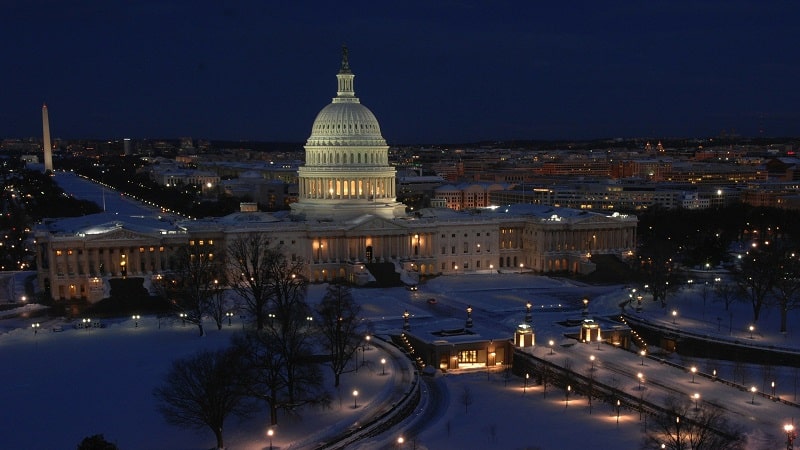
Lawmakers on Tuesday took steps to require greater transparency from the Pentagon over how it is spending funds provided for the Golden Dome missile-defense program, adding new oversight requirements to the fiscal year (FY) 2026 defense spending bill.
In a report accompanying the spending bill, House and Senate appropriators supported Golden Dome’s national security objectives but directed Pentagon officials to provide a comprehensive spending plan, system architecture, and regular updates, citing a lack of sufficient information to conduct oversight of the multibillion-dollar effort.
“Due to insufficient budgetary information, the House and Senate Appropriations Subcommittees were unable to effectively assess resources available to specific program elements and to conduct oversight of planned programs and projects for fiscal year 2026 Golden Dome efforts,” the report states.
The Golden Dome program, announced by executive order on Jan. 27, 2025, is the centerpiece of President Donald Trump’s missile defense strategy. Described by the administration as a “next-generation missile defense shield,” it is intended to protect the United States from hypersonic and other advanced missile threats.
The president estimates the program will cost $175 billion to develop by 2028.
In last year’s reconciliation bill, Congress approved an initial investment of $24.4 billion, with $18.8 billion appropriated for next-generation missile defense technologies and $5.9 billion for layered homeland defense. The enacted legislation did not specify the extent to which the funding was for existing programs, projects, activities, or new lines of effort across the Defense Department (DOD) – rebranded as the War Department by the Trump Administration.
Under the bill, the defense secretary, working with the director of Golden Dome, must submit a comprehensive spending plan to congressional defense committees within 60 days of enactment. The plan must detail obligations and expenditures by program, include cost, schedule, and performance metrics, and break out discretionary and mandatory funds for FY 2025 through 2027. It must also be tied to a finalized system architecture.
Beginning in FY 2028, the DOD would be required to submit a separate annual budget justification volume focused solely on Golden Dome. The bill also directs the program office to provide an integrated master test plan covering flight, ground, and cyber testing, and to deliver quarterly updates on budget execution and progress toward an initial operational capability by 2028.Democrats have long pressed for more detailed information on Golden Dome spending, while Republicans have largely supported the program’s cost and opposed any actions to block funding in response to the DOD’s lack of information. Under the fiscal 2026 defense spending bill, Congress would still provide funds for Golden Dome but would require the DOD to submit a comprehensive spending plan, system architecture, and regular updates.
The bill includes about $13.4 billion for the Golden Dome for America missile defense initiative, with $9.6 billion for Missile Defense Agency programs and $3.8 billion for Space Force efforts.
Golden Dome Director Gen. Michael Guetlein has said since last summer that the Pentagon is working on a formal blueprint to clarify the program, though no detailed plan has been released publicly.