
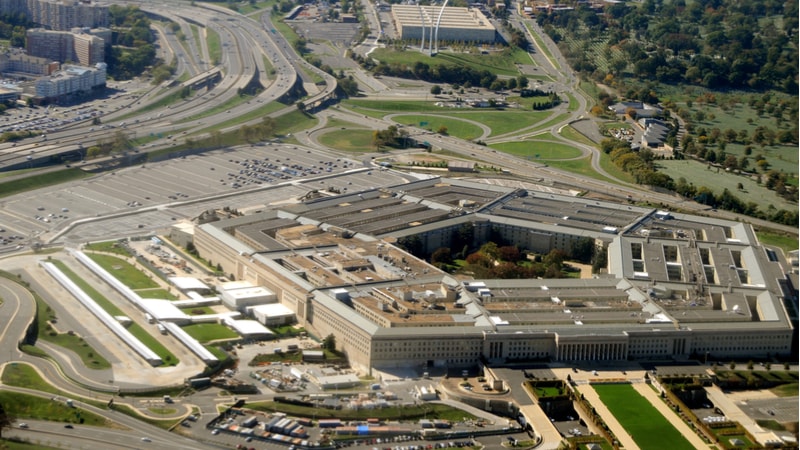
More than 180 experts from the Pentagon and federal agencies met last week to begin a three-year effort to develop counter-small unmanned aircraft system (UAS) capabilities aimed at protecting U.S. forces and the homeland.
The summit marked the start of work for Joint Interagency Task Force 401 (JIATF 401), created in August when Secretary of Defense Pete Hegseth directed Army Secretary Dan Driscoll to establish the group. The task force is expected to operate for 36 months.
“This was an opportunity to bring together all of the services, all of our interagency partners that have shared interests and equities with countering small UAS threats, because no one agency can solve this on their own,” said Army Brig. Gen. Matt Ross, JIATF 401 commander.
“What we’re really trying to do is expand the community of interest into a community of action and make sure we’re taking tangible steps to defeat the UAS threat we face on a daily basis,” he said.
About 50 representatives from the Defense Department (DOD) – rebranded as the War Department by the Trump administration – the Department of Homeland Security, FBI, Transportation Department, Federal Aviation Administration, and other agencies attended the introductory session at the Mark Center in Alexandria, Va.
Task force participants emphasized the collaborative benefits of the initiative. Daniel Tamburello, undersecretary of science and technology at DHS, said task force coordination can reduce duplication and support interoperability. Michael Torphy, unit chief for the FBI’s UAS and counter-UAS programs, said the task force will strengthen the bureau’s work with partner agencies. He highlighted the new National Counter-UAS Training Center in Huntsville, Ala., which trains law enforcement personnel ahead of major events, including the World Cup.
A Defining Threat of our Time
Ross said small UAS are becoming more common and more capable, creating surveillance and strike risks once limited to state adversaries.
“Unmanned systems are a defining threat for our time, and I say that because they’re prolific, they’re evolving quickly, and they’re no longer confined to combat,” Ross said.
The task force’s three lines of effort to defeat the counter-small UAS threats are “defending the homeland, supporting warfighter lethality, and enabling joint training, he said.
The task force’s initial priorities include the National Capital Region, the southern border, and the June 2026 FIFA World Cup, which is classified as a national special security event.
In the National Capital Region, the task force will evaluate how multiple agencies’ sensors track threats and how information is passed to decision-makers and those authorized to act.
Addressing the threat of UAS at the border requires improved communication and data sharing, Ross said.
According to Ross, U.S. Northern Command and Joint Task Force Southern Border personnel have reported some 3,000 drone incursions over the border in the past year and have seen more than 60,000 drones just south of the U.S. border.
“We need a common air picture that includes drones,” Ross said. “In some cases, we need cross-domain solutions that will allow us to see data that’s picked up on a secret radar and an unclassed sensor. We need to proliferate active and passive sensors that provide air situational awareness along the southern border.”
“We’re not there yet, but we’re making progress,” Ross said.
For the World Cup, JIATF 401 will work to ensure that security personnel can purchase counter-UAS capabilities through the Defense Logistics Agency.