
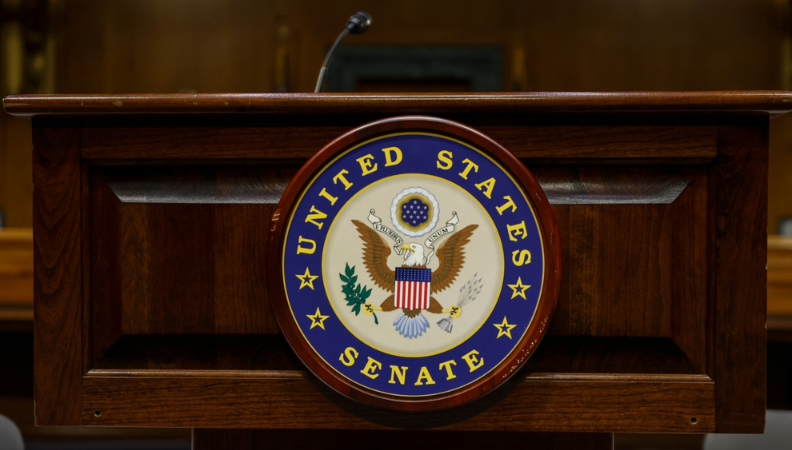
The Senate today passed the fiscal year (FY) 2026 defense authorization bill, voting 77-20 to send the measure to President Donald Trump, who has said he will sign it.
The FY 2026 National Defense Authorization Act authorizes $900.6 billion in defense spending, about $8 billion more than the White House requested.
The House approved the bill Dec. 10.
The legislation includes sweeping changes to how new technology is acquired at the Defense Department (DOD) – rebranded as the War Department by the Trump administration – aiming to accelerate development and deployment.
“We’ve worked together to deliver the most significant acquisition reforms in a generation – cutting red tape, accelerating decision-making, and improving our ability to get modern capabilities into the hands of our troops on time and on budget,” according to a joint statement by House and Senate Armed Services Committee leaders.
The bill establishes an accelerated requirements process intended to draw on existing industry solutions rather than custom-built systems, centralizes program management under a single portfolio acquisitions executive, and requires earlier planning for sustainment.
DOD is also directed to prioritize commercial off-the-shelf technology before launching new development programs, reduce compliance burdens for small businesses, and strengthen procedures for soliciting commercial solutions.
“The FY26 NDAA takes critical steps to fundamentally reform and improve defense acquisition practices to ensure U.S. warfighters have timely access to AI and other cutting-edge commercial technologies at the best value. These new measures will also provide much needed certainty to the private sector and support its ability to help the government implement best-in-class solutions to meet agencies’ missions,” said Gordon Bitko, executive vice president of public sector for the Information Technology Industry Council, in a statement.
Other Provisions
Notably, a reauthorization of the Technology Modernization Fund, which supports civilian agency IT upgrades, was not included. The fund is set to expire Dec. 12 without further congressional action.
Several cyber-related provisions are also included in the NDAA. Within three months of enactment, senior defense officials are required to use mobile devices with enhanced security protections, including encryption, obfuscation of device identifiers and continuous monitoring.
Defense Secretary Pete Hegseth is directed to develop a department-wide policy for secure use of artificial intelligence and machine learning, including workforce training to identify and mitigate vulnerabilities.
The legislation also requires the defense secretary to harmonize cybersecurity regulations across the DOD’s industrial base by June 2026 to reduce duplicative and inconsistent requirements.
Other provisions codify President Trump’s executive order on expanding U.S. drone and counter-drone capabilities. The bill also assigns new mandates to the Pentagon’s All-domain Anomaly Resolution Office, including expanded briefings to Congress on unidentified anomalous phenomena (UAP), streamlined reporting requirements and a review of classification guides governing UAP-related information.
Beyond technology and policy reforms, the bill also provides a 3.8% pay raise for U.S. service members.