
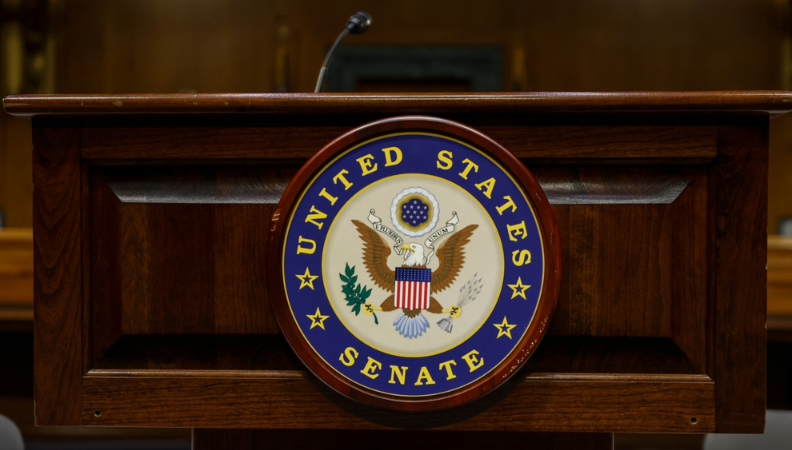
The United States can play and win the technology long game, but only if Washington backs its ambitions with widespread innovation, clearer rules, and stronger alliances, according to Sens. Todd Young, R-Ind., and Maria Cantwell, D-Wash.
Speaking Wednesday at a CSIS event in Washington, the senators said the U.S. needs to do more to strengthen its global influence on emerging technologies. They called for stronger, long-term investment to spur innovation and support that effort.
“We need energy to sustain the age of AI [artificial intelligence], and permitting reform will facilitate that, as well as the deployment of more data centers. We need clearer rules … so that we can enable this next generation of advanced manufacturing to occur. And then [the] workforce will be key across all these tech areas, but I think of semiconductors in particular,” Young explained.
Currently, a lack of speed – largely due to unclear regulations – is holding back innovation and growth, he said.
“[I]nvestment will stop if the investors lose faith in our regulatory system, because it becomes impossible to assess what your hurdle rate is for any given investment,” Young said. “We should, on an ongoing basis, be weeding the garden. We need to be optimizing these systems.”
To speed innovation further, Cantwell said the United States needs to support technology growth across the nation, instead of concentrating on the East and West Coasts.
“If America is going to compete with China, we need that innovation to be across the United States,” Cantwell said. “This is why the tech hub idea in the CHIPS and Science Act became so popular with our colleagues and so popular overall … it’‘s almost like saying the high– tech economy is coming to a theater near you, and the level of investment that’‘s now happening in and around Columbus [Ohio] becomes its own generator of more investment in [research and development].”
The CHIPS and Science Act – passed in 2022 by Congress to incentivize semiconductor makers to establish new U.S. manufacturing operations – not only supports U.S. innovation and reduce reliance on global supply chains, but also drives democratic governance around the globe, Young added.
“The CHIPS and science act is often perceived … as a domestic initiative,” Young said. “But I actually thought it was more of a foreign policy plan, an economic security plan, because from the beginning … our goals were never to become independent of other countries.”
But the United States must do more to de-risk global supply chains, Young added. He pointed to the global COVID-19 pandemic, which exposed a failure in tech supply chains – that markets didn’t quickly fix critical shortages – and said that the United States must work with allies to proactively map risks and build redundancy before the next crisis.
Building stronger alliances doesn’t stop there, according to Cantwell. She said the United States should counter China’s growing influence over global tech deployments by forging a coalition of leading democracies to set shared standards and steer purchasing toward countries that meet those rules.
“If we were successful at really getting countries to embrace that … then we wouldn’t be running around the globe trying to rip out Huawei equipment, which is what we’re doing now,” Cantwell said, referring to the removal of communications equipment and services produced or provided by China-based companies Huawei Technologies and ZTE.
“I guarantee you we’re not putting enough pressure on China to live up to those standards,” Cantwell said, adding that without action, “there’ll be another version of [Huawei] down the road.”