
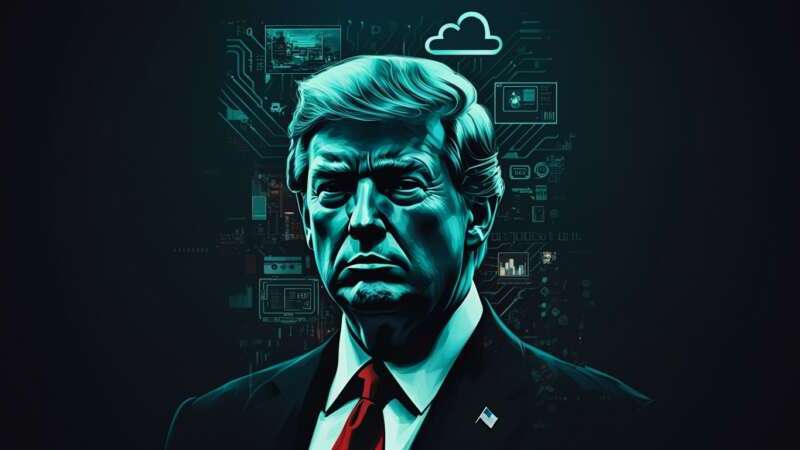
President Donald Trump signed an executive order Thursday to undermine state laws on artificial intelligence (AI), calling instead for a “minimally burdensome” single framework to regulate the AI industry.
The order directs the attorney general to lead an AI Litigation Task Force that will identify and legally challenge state laws that don’t support “the United States’ global AI dominance.” If states don’t rescind their laws, Trumps said that broadband funds authorized under the Broadband Equity Access and Deployment (BEAD) Program will be withheld.
“We want to have one central source of approval,” Trump said while signing the order in the Oval Office. “China is unified because they have one vote. That’s President Xi [Jinping]. He’s just doing it, and that’s the end of that. You know, we have a different system, but we have a system that’s good, but we only have a system that’s good if it’s smart.”
Trump said the ban is intended to bolster AI innovation, citing long-time concerns of his administration that a patchwork of AI laws will stifle innovation and hurt AI start–ups.
An 10-year moratorium on state AI laws was considered in the tax and spending bill earlier this summer, but after strong bipartisan pushback, it failed on a Senate vote of 99-1.
All 50 states and U.S. territories introduced AI legislation, and 38 states adopted more than 100 AI laws in the past year, according to the National Conference of State Legislatures.
Some state AI laws won’t be contested by the Trump administration, according to the order, including those that relate to child safety, AI compute and data center infrastructure, state government procurement and use of AI, and other topics “as shall be determined.”
White House AI and Crypto Czar David Sacks said that the order specifically targets “onerous and excessive state regulations.” While Sacks did not specify what laws meet that criteria, he previously said that a patchwork of state AI laws would encourage “woke AI.”
Still, Thursday’s order received significant pushback from members of Congress and state lawmakers. Rep. Doris Matsui, D-Calif., who serves as ranking member of the House Energy and Commerce Communications and Technology Subcommittee, called the move “illegal federal coercion,” and added that it is “a gift to big tech – stripping away accountability when AI is becoming more powerful and deeply embedded in people’s lives.”
Florida Gov. Ron Desantis also criticized the move in a post to X on Monday when Trump first announced his intent to issue the order, writing, “An executive order doesn’t/can’t preempt state legislative action … Congress could, theoretically, preempt states through legislation.”
Still, Trump called the order a “common sense” move, and said that “we have, I think, great Republican support. I think we probably have Democrat support too.”
The order directs the secretary of commerce to conduct evaluations that will “at a minimum, identify laws that require AI models to alter their truthful outputs, or that may compel AI developers or deployers to disclose or report information in a manner that would violate the First Amendment or any other provision of the Constitution.”
The order also directs the Federal Communications Commission to consider a federal AI reporting and disclosure standard, and White House advisors to draft legislative recommendations to create a uniform federal AI framework that overrides conflicting state rules.
The order generally received positive reviews from industry. The global tech trade association Information Technology Industry (ITI) Council welcomed the order as a way of preventing conflicting state laws.
“We stand ready to work with the Trump Administration and Congress to prepare a legislative recommendation that promotes American AI leadership and innovation and ensures all Americans can reap the benefits this transformational technology offers,” ITI said in a statement.