
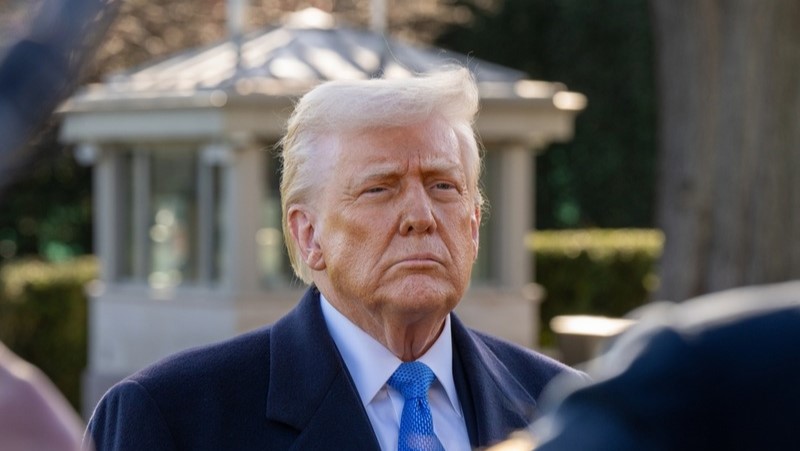
President Donald Trump officially secured the 25% share of profits made on advanced Nvidia and AMD semiconductors shipped abroad through a proclamation he signed Wednesday afternoon.
Last month, Trump decided to allow the sale of Nvidia-manufactured chips used in advanced artificial intelligence (AI) to China and other nations if the U.S. government gets 25% of the profit.
The president said those sales will occur “under conditions that allow for continued strong National Security,” and that the plan was well received by Chinese President Xi Jinping.
While the Nvidia H200 and AMD MI325X chips will be tariffed, a White House fact sheet on Trump’s memo said that the “tariff will not apply to chips that are imported to support the buildout of the U.S. technology supply chain and the strengthening of domestic manufacturing capacity for derivatives of semiconductors.”
One of the Trump administration’s priorities under its AI Action Plan is a full-stack AI export package that will include related hardware, models, software, applications, and standards. The aim of that program is to become the global leader in AI standards and technology.
However, those planned exports have been to allied nations, not adversarial ones, such as China. This has fueled bipartisan concern that the sale of advanced U.S. chips to China would give the U.S. military’s edge away.
Late last year, the Trump administration agreed to suspend through a new export-control “affiliates rule” that had barred chip sales to subsidiaries of Entity List companies through November 2026. That move temporarily rolled back a key restriction aimed at preventing Chinese firms from using shell companies to obtain advanced U.S. technology.
Trump’s memo additionally paved the way for future tariffs on chip imports. The White House said that broad tariffs may be imposed “on imports of semiconductors and their derivative products, as well as an accompanying tariff offset program to incentivize domestic manufacturing.”
Those tariffs on chip imports will help reduce reliance on foreign supply chains by “incentivizing domestic production of semiconductors,” the White House said.