
Legislation reintroduced in the House, and filed in the Senate, on March 31 would direct the Labor Department (DOL) to create a dedicated grant program to increase access to registered apprenticeship programs in cybersecurity. […]
Rep. Michael Baumgartner, R-Wash., led a bipartisan group of lawmakers today in introducing the Multilateral Alignment of Technology Controls on Hardware (MATCH) Act, a bill aimed at closing gaps in export controls on semiconductor manufacturing equipment (SME). […]
The House Veterans’ Affairs Subcommittee on Oversight and Investigations on Thursday examined software waste and data privacy risks at the Department of Veterans Affairs (VA), as lawmakers considered two bills aimed at tightening oversight of IT assets and contractor data practices. […]

A group of House Democrats is pushing a proposal that would repeal a December executive order to preempt state artificial intelligence (AI) laws. […]
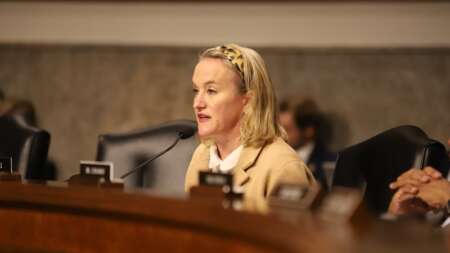
A new bill introduced by Rep. Nikki Budzinski, D-Ill., would require the Department of Veterans Affairs (VA) to make measurable improvements to its Electronic Health Record Modernization (EHRM) program or ditch the contract with Oracle Cerner altogether. […]

Rep. Zoe Lofgren, D-Calif., took another stab Thursday at legislation aimed at regulating the way consumers’ data is collected and used online, reintroducing the Online Privacy Act for the fourth time since 2019. […]

The National Quantum Initiative Act (NQI) needs some updates to enhance its efficiency and improve its oversight efforts, a federal watchdog warned ahead of a Senate committee markup on the act’s reauthorization. […]

The Senate’s draft proposal for national artificial intelligence (AI) legislation unveiled Wednesday would preempt state laws by focusing on regulations that protect the “4 Cs” – children, creators, conservatives, and communities. […]
A bipartisan bill introduced to the Senate on Wednesday would create a commission of lawmakers and industry leaders to develop policy recommendations to address future economic and workforce impacts of artificial intelligence (AI). […]
A bipartisan pair of representatives reintroduced an act on March 6 to include quantum molecular simulations and modeling in the National Quantum Initiative (NQI). […]
The House Energy and Commerce Committee voted on March 4 to approve a bill that would require Senate confirmation for an assistant secretary position at the Department of Energy (DOE) to lead the agency’s Office of Cybersecurity, Energy Security, and Emergency Response (CESER). […]
House and Senate lawmakers from both sides of the aisle have introduced new legislation that would create a “Lending.gov” shared services platform to be used by federal agencies that provide lending services. […]
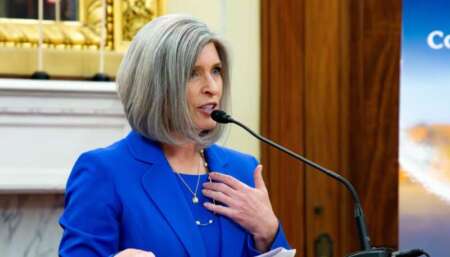
The Senate unanimously passed legislation on Tuesday that would reauthorize the federal Small Business Innovation Research (SBIR) and Small Business Technology Transfer (STTR) programs. […]

A bipartisan group of senators is reigniting efforts to codify the National Institute of Standards and Technology’s (NIST) Center for Artificial Intelligence (AI) Standards and Innovation (CAISI) and create new standards and testbeds for the national laboratories to accelerate AI innovation. […]
Sen. Mike Lee, R-Utah, is leading a bipartisan congressional effort to reauthorize a legal provision with additional safeguards to prevent the government’s surveillance of Americans’ digital data without a warrant. […]
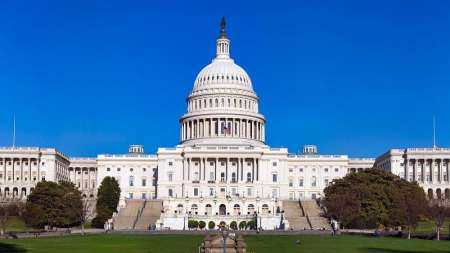
A bill that was hailed by the Senate for its aviation safety provisions and unanimously passed, was shot down by the House in a narrow vote Tuesday after the Pentagon withdrew its support. […]

Rep. James Walkinshaw, D-Va., introduced a bill on Monday that aims to strengthen the Department of Veterans Affairs (VA) Veteran Employment Through Technology Education Courses (VET TEC) program, which supports veterans training to work in high-tech fields. […]
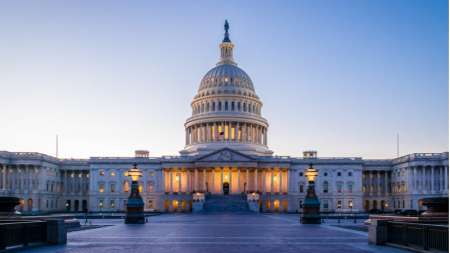
Companies that teach employees how to use and build artificial intelligence (AI) systems could receive a new tax credit for each worker they train under a bipartisan proposal introduced Wednesday by Reps. Josh Gottheimer, D-N.J., and Mike Lawler, R-N.Y. […]
Legislation introduced by Rep. Nathaniel Moran, R-Texas, on Feb. 11 would deny tax incentives to companies that use foreign adversary-controlled technology. […]
A bipartisan group of senators are pushing for a new modernized and digital environmental permitting system under a legislative proposal introduced Tuesday. […]

Federal workers would receive a 4.1% pay increase in 2027 under a new proposal introduced Tuesday by Rep. James Walkinshaw, D-Va., and Sen. Brian Schatz, D-Hawaii. […]
Rep. April McClain Delaney, D-Md., said she hopes to introduce new legislation within a month focused on standards for quantum technology and the development of a federal artificial intelligence (AI) regulatory framework. […]
Key cybersecurity bills aimed at securing the nation’s energy infrastructure and electric grid are advancing to the full House Energy and Commerce panel after passing out of the House Subcommittee on Energy. […]
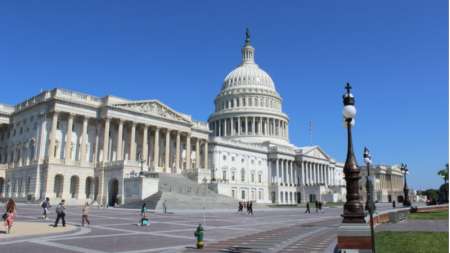
Lawmakers on the House Oversight and Government Reform Committee on Wednesday advanced several pieces of legislation – with overwhelming bipartisan support – aimed at strengthening the federal cybersecurity workforce, streamlining procurement, and reducing national security risks in government supply chains. […]
Rep. James Walkinshaw, D-Va., is leading a group of House Democrats in a legislative proposal to pay all federal employees, service members, and contractors during any federal shutdowns in fiscal year 2026. […]

A bipartisan pair of representatives are proposing a federal identity fraud prevention innovation grant program for states to modernize their identity systems and create secure digital IDs. […]

A new legislative proposal introduced by Rep. Blake Moore, R-Utah, on Friday would use artificial intelligence (AI) to identify redundant and outdated rules in the Code of Federal Regulations (CFR). […]

The House on Jan. 20 voted to approve the AI for Main Street Act, which would direct the U.S. Small Business Administration (SBA) to provide a range of help to small businesses that are looking to implement artificial intelligence (AI) technologies. […]

New legislation introduced in the House would block the use of China-controlled apps on federal government devices. […]

New legislation filed in the Senate would instruct the Defense Department (DOD) to redouble efforts to recruit and retain members of the agency’s cybersecurity workforce and help address a double-digit percentage shortfall in DOD’s total cybersecurity employee rolls. […]