Since reorganization is a perennial issue in the Federal government, one would expect substantial academic literature to exist on this matter. While there is a considerable body of work on the histories of reorganization efforts (especially the various executive branch commissions), analysis of existing organizational arrangements (narrative pieces bemoaning overlap and duplication), and on what best might be called the politics of reorganization, the relationship between institutional and procedural reform and the policy output of the bureaucracy remains almost wholly unresearched.
Indeed, a review of the current state of actual knowledge concerning reorganizations and their effects is an unrewarding task, for knowledge of this kind is impressively slight. Dean Mann and Ted Anagnoson concluded, after an examination of the reorganization literature, that there was little explicit work on the results of reorganizations:
Almost nobody has asked the question: What difference have these reorganization plans and executive orders made? How have they been implemented and with what results?
The focus of this article is on these specific topics. It draws from my own work in the government not only on various organizational study teams, but more importantly from being deeply involved in creating two new agencies in government and abolishing two others.
As noted above, the what, what’s wrong, and to a certain extent, the what ought to be done, have been adequately covered–to say the least. But the specific consequences of restructuring efforts have been largely ignored. Let me begin this undertaking by assessing accomplishments in terms of the “goals” of reorganization. Reorganizations are usually designed to:
- Simplify and streamline;
- Bring about greater efficiency and economy;
- Place program oversight under a single administrator;
- Help make possible effective program management, sound financial control, and coherent delivery of services by consolidating program areas badly fragmented in the existing organization structure;
- Simplify and strengthen the linkage between policy development and program administration;
- Eliminate program fragmentation and end confusing organizational divisions;
- Prevent fraud and abuse;
- Achieve savings;
- Reduce staff; and,
- Make (the entity) more responsive to the millions of Americans that the Congress has directed (the entity) to serve.
These goals or objectives of reorganization seem quite consistent with traditional public administration doctrine and characteristic of what Harold Seidman regarded as “administrative orthodoxy.” It is somewhat difficult, therefore, to measure success in terms of such “proverbs” or “organizational platitudes,” but let’s seek to dig a bit deeper.
A number of the goals reflect a concern with structure (e.g., simplify and streamline, efficiency and economy, consolidating program areas, simplify linkages, end organizational divisions, and so on). However, during reorganizations, while a number of consolidations occur, numerous others remain. This is not surprising since in a government with multiple objectives and thousands of programs it is likely impossible to organize so that issues do not cross organizational lines. In fact, there probably is no way to structure the government so that all programs with interrelated objectives are in only one component. Certain organizational efficiencies may occur, but a number of others remain–untouched or, in some cases, caused by the reorganization. Reorganizations end certain duplications or program overlaps while creating new ones.
Other goals reflect a major concern of traditional public administration doctrine: economy and efficiency. But tracking agency savings, as almost any seasoned budget officer would tell you, is “dealing with funny money.” Most reorganization assessments seem to verify Rufus Miles’ assertion that economy as a ground for major reorganization is a will-o’-the-wisp.
In one of the departmental reorganizations I staffed, the secretary said as he announced the reorganization:
I recognize that it is far easier to announce a fundamental reorganization than to implement proposed plans adequately and to change materially the way in which our money is spent and our citizens are served.
He was addressing an issue that has received little attention: implementation of organizational reforms. Donald Van Meter and Carl Van Horn have offered four reasons for the neglect of policy implementation:
- There is the naïve assumption that implementation follows automatically after policy formulation and that results do not deviate from expectations.
- The implementation process is assumed to be a series of mundane decisions and interactions.
- The focus on analysis of policy alternatives and rational policymaking has excluded attention “of the lower echelons of agencies responsible for implementation.”
- The enormous difficulties involved in studying implementation.
These same reasons appear valid for explaining the neglect of reorganization implementation. While the constraints are formidable, what can be said about this important matter.
Rufus Miles has noted that reorganizations have traumatic effects that should be carefully weighed. Of course, as Miles noted, organizations “vary widely in the degree to which they disrupt the skein of human relationships that are the communications and nerve networks of every organization.”
Some reorganizations cause little or no disruption, while others are traumatic. But any reorganized agency undertakes a heavy load of bureaucratic activities. People have to be reassigned; procedures have to be developed; policies have to be established; money has to be spent in a way that can be made accountable; office space and furniture have to be obtained. Personnel has to review proposed organization structures, review and rewrite position descriptions, fill new and existing vacancies, transfer employees, handle union concerns, and advise employees of their rights during reorganization.
The magnitude of these endeavors can only be understood by someone familiar with the complexity and arduousness of the Federal personnel system. Similar challenges exist in budget, finance, grants, acquisition, security, and other administrative services.
Implementation is almost considered to follow automatically, a rather common occurrence, according to I.M. Destler and the Government Accountability Office (GAO):
For reorganization, as for any other change, implementation is the bottom line. Without it, the whole exercise is show and symbolism. Yet in real-life attempts at reorganization, serious concern with implementation is typically too little and too late. Enormous attention is devoted to analyzing and deciding what changes should be made. The problem of getting from here to there is addressed only belatedly. To paraphrase Erwin Hargrove, implementation often seems the “missing link” in reorganization.
So what lesson can we draw from previous reorganizations? First, reorganization is not likely to make government measurably cheaper. Second, unwarranted stress should not be placed on efficiency as grounds for reorganization. The simple fact is that public administration and organizational theorists know very little about what type of reorganization promotes efficiency; in some cases they have turned to consolidation, in other cases, to decentralization. Third, government reorganizers must pay special attention to the problems that can be caused by excessive tinkering. As Miles has noted.
Traumatic reorganizations may be analogized to surgical operations. It is important that their purposes be carefully assessed and a thoughtful judgment reached that the wielding of the surgical knife is going to achieve a purpose that, after a period of recuperation, will be worth the trauma inflicted. And the surgical knife should not be wielded again and again before the healing process from earlier incisions has been completed.
Finally, this article should make obvious that since it is only through effective implementation that adopted reorganization proposals can bring about results; implementation is a crucial part of the reorganization process. And, it appears that implementation strategy cannot be left until after a reorganization program has been approved.







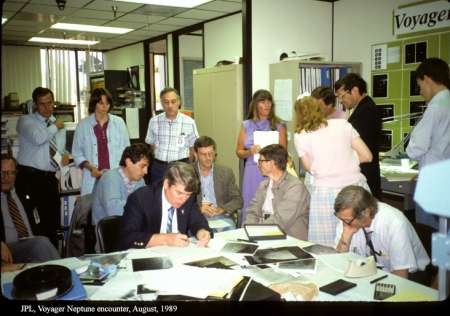 Nowhere is this example more apparent than at NASA. Take, for example, NASA’s Voyager 2 program. NASA scientists and engineers have been working on Voyager 2 for 40 years. It’s the only spacecraft to have ever visited Uranus and Neptune, and is currently making its way to interstellar space. The technical achievements recorded during missions to photograph Uranus, Neptune, and Neptune’s moons are without parallel and were done by career NASA employees.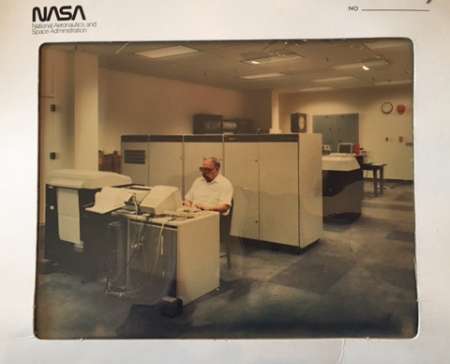
 MeriTalk compiles a weekly roundup of contracts and other industry activity. Stay up to date on everything that’s happening in the Federal Information Technology community. MeriTalk.com keeps you informed about the topics that mean the most to you and creates a targeted platform for cooperation, public-private dialogue, highlighting innovation, and sharing informed opinions. This week: News from
  As the State Department works to gain international support for its cybersecurity framework, experts said that global norms and deterrence won’t be enough to convince state actors not to influence elections through cyber means
  The Office of Management and Budget unveiled its plan to reorganize Federal agencies, called the “Comprehensive Plan for Reforming the Federal Government and Reducing the Federal Civilian Workforce,” which responds to President Trump’s March 13 executive order to OMB. The plan requires agencies to take immediate action on reducing their workforce and saving money, and submit a long term plan for maximizing worker performance by the end of June. Agencies will also be required to submit an Agency Reform Plan within 180 days to modernize
  John Short, the program executive for the VistA Evolution program at the Department of Veterans Affairs, has been tapped to take over as the acting deputy director of the DOD/VA Interagency Program Office responsible for ensuring electronic health record sharing between the VA
  The National Geospatial-Intelligence Agency needs to attract new tech talent with new ideas and a desire to work on something bigger and more important than the next popular dating app. One of the ways the agency hopes to do that is by continuing to work with the government’s own in-house
  The government needs to create and fund new hiring programs to fill Federal cyber vacancies, according to experts testifying before the House IT Subcommittee on Tuesday. During the hearing, IT subcommittee chairman Will Hurd, R-Texas, floated the idea of creating a Cyber National Guard that would pull workers from the private sector for short stints of work
  President Donald Trump ran his campaign on the promise of a wall that would run the length of the U.S.-Mexico border. While Secretary of Homeland Security John Kelly still does not know what the wall will look like, he said it will probably not resemble the single concrete partition
 Agencies at the state and local level need to adopt cybersecurity practices that cater to their individual needs, according to many of the experts who testified at a Senate hearing. Patricia Hoffman, acting assistant secretary of DOE’s Office of Electricity Delivery and Energy Reliability, stated that the agency does not have a single model for cybersecurity regulations, but rather recommends certain components that could contribute to a
  More than two years after Congress passed the Federal Information Technology Acquisition Reform Act—the biggest overhaul of Federal IT acquisition in decades—most Federal chief information officers say they still don’t have the authority necessary to manage technology
  The IT team at the Federal Communications Commission has been working to re-prioritize its projects to align with the goals of the agency’s new leadership, which has forced officials to make tough decisions about modernization. David Bray, the chief information officer at the FCC, and his team presented the projects that they are working on to Chairman Ajit Pai earlier this month to get his opinion on where the team should focus its efforts. Pai wants the IT team to focus on the development and back-end technology for the FCC’s actions including Mobility Fund Phase II and Connect America Fund Phase II, which serve to bring broadband
  After the huge success of the Hack the Pentagon bug bounty program, members of the Department of Defense and participating organizations are calling on other government agencies to copy the DoD program
  The Department of Transportation is holding off on creating new rules for automated vehicles and unmanned aerial systems because of President Donald Trump’s limit on new regulations, according to DOT officials. DOT has worked on a proposed rulemaking that would require cars to include vehicle to vehicle (V2V) communications, which would allow cars to talk to one another